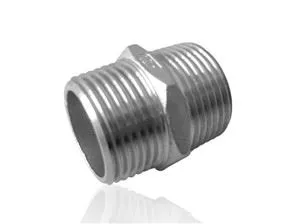

Your production line grinds to a halt. A critical fluid system springs a leak, causing costly damage and unplanned downtime. The search for the cause begins, often focusing on major equipment like pumps or tanks. But more often than not, the real culprit is one of the smallest, most overlooked components in the entire system: a single, failed fitting.
Subpar stainless steel fittings are a ticking time bomb in any industrial application. While cutting corners on these small parts may seem like a minor cost-saving measure, the long-term price of failure is astronomical. Let's break down the hidden costs and how to avoid them by making smarter choices from the start.
1. The Material Mismatch: When Grade Isn't Good Enough

Pitting corrosion on a standard 304 grade fitting (right) compared to a pristine, corrosion-resistant 316 grade fitting (left)
The single most common cause of premature failure is choosing the wrong material grade. Corrosion isn't a defect; it's a chemical reaction waiting to happen.
- The Problem: A purchasing agent, focused on cost, sources standard 304 grade plumbing fittings for a system that has exposure to salt water or harsh cleaning chemicals. Within months, pitting corrosion begins, weakening the fitting until it fails.
- The Hidden Cost: Catastrophic leaks, product contamination, and the need for a complete system overhaul.
- The Solution: Understand your environment. While 304 is excellent for general use, any application with chlorides, acids, or marine exposure demands the superior corrosion resistance of 316 stainless steel hose clamps, valves, and fittings. The debate of stainless steel vs brass fittings also comes into play, but for strength and broad chemical resistance in industrial settings, stainless steel is typically the winner. Always specify marine grade fittings when the application calls for it.
2. The Connection Catastrophe: Weak Links in the Chain

A mobile stainless steel filtration skid for the food industry, featuring polished pipes, sanitary butterfly valves with blue handles, and secure tri-clamp fittings in a clean environment.
A fitting is only as good as its connection. The wrong type of connection for your pressure and maintenance requirements is a recipe for disaster.
- The Problem: Using stainless steel threaded pipe fittings in a high-vibration, high-pressure system. Over time, the vibrations can loosen the threads, creating a slow, often undetectable leak until it becomes a major issue.
- The Hidden Cost: Lost product, safety hazards, and gradual system inefficiency.
- The Solution: Match the connection to the application. For permanent, leak-proof integrity in critical systems, nothing beats the strength of butt weld fittings. For smaller-diameter pipes, socket weld fittings provide a strong seal. For robust, separable connections, especially for valves and equipment, stainless steel flanges are the industry standard.
3. The Compliance Crisis: The High Price of Cutting Corners

Upholding the highest standards in critical manufacturing. NSF certification (up)provides the trusted framework for safety and quality, ensuring that environments like this pharmaceutical facility (down)· operate with the utmost purity and product integrity.

In industries like food, beverage, and pharmaceuticals, "good enough" is never good enough. Compliance is mandatory.
- The Problem: A facility uses non-certified stainless steel hose fittings in a potable water line or a food processing system to save money. During an audit, the non-compliance is discovered.
- The Hidden Cost: Forced shutdowns, hefty fines, product recalls, and irreparable damage to your brand's reputation.
- The Solution: Never compromise on certification. Insist on NSF certified components for any application involving human consumption. Partner with a fittings supplier who understands the importance of traceability and can provide documentation for food grade stainless steel fittings. This isn't just a quality issue; it's a legal and ethical one.
The Ultimate Solution: A Partnership in Quality

Our partnership is built on quality. We ensure every component meets rigorous standards through meticulous, hands-on inspection.
Avoiding these costly failures doesn't come down to a single product choice. It comes down to a strategic sourcing decision. The best way to guarantee the quality, compliance, and suitability of your components is to partner with a vertically integrated stainless steel fittings manufacturer.
A true OEM stainless steel fittings manufacturing partner offers:
- Expert Guidance: They can help you select the right grade and fitting type, from a swing check valve to a compression fitting.
- Precision Manufacturing: With in-house custom investment casting services and CNC machining for stainless steel parts, they control quality from raw material to finished product.
- Reliable Sourcing: As leaders in the Vietnam manufacturing space, companies like WIN-VIET PRECISION MACHINERY offer a stable, high-quality supply chain for everything from bulk stainless steel fittings to complex, custom-engineered components.
- Don't wait for a failure to reveal the weak links in your system. Invest in quality from the start.
Protect your operations and your bottom line. Contact WIN-VIET today to request a quote for high-quality, reliable fittings tailored to your exact needs.
Download our product catalogue to see the complete collection of valves and fittings.
Leave us a message for expert support or a wholesale quote.
WhatsApp us now for fast, direct assistance.