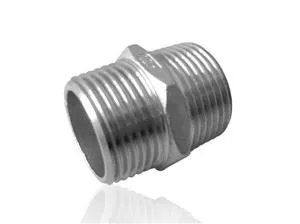

The hardenability of stainless steel pipe fittings after welding is relatively large, and cracks easily occur. If welding with typical stainless steel pipe fittings is adopted, preheating above 300℃ and slow cooling at 700℃ after welding must be carried out. If the weldment cannot be subjected to post-weld heat treatment, stainless steel pipe fitting electrodes should be used.
In order to improve the corrosion resistance and weldability of stainless steel pipe fittings, appropriate amounts of invariant elements such as Ti, Nb, Mo, etc. are added. The weldability is better than stainless steel pipe fittings. When using the same typical chromium stainless steel electrode, it should be preheated above 200 ℃ and tempered at 800 ℃ after welding. If the weldment cannot be heat treated, chromium-nickel stainless steel electrode should be used.
Stainless steel pipe fittings have exquisite corrosion resistance and oxidation resistance, and are widely used in chemical, fertilizer, petroleum, and medical machinery manufacturing.
There are titanium calcium type and low hydrogen type for stainless steel pipe fittings. Titanium-calcium type can be used for AC and DC, but the penetration depth is relatively shallow during AC welding, and it is convenient for redness, so DC power supply is generally used.
Stainless steel pipe fittings have certain corrosion resistance (oxidizing acid, organic acid, cavitation), heat resistance and wear resistance. It is generally used as a material for equipment and furnishings such as power stations, chemicals, and petroleum. The weldability of stainless steel pipe fittings is poor, so you should pay attention to the welding process and choose suitable welding electrodes before heat treatment.
The electrode should be kept dry during operation. The titanium calcium type should be dried at 150°C for 1 hour, and the low hydrogen type should be dried at 200-250°C for 1 hour (do not dry repeatedly, otherwise the coating will easily crack and peel). Beware of the coating of the electrode. Sticky oil and other dirt, so as not to increase the carbon content of the weld and affect the quality of the weldment.