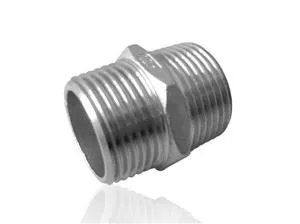

Due to the different sizes of stainless steel pipe fittings, according to the unique welding of stainless steel pipe fittings, the heat input is reduced as much as possible, so two methods of manual arc welding and argon arc welding are used. For d> 159 mm, argon arc welding is used for bottoming. Arc welding cover. All argon arc welding with d≦Φ159 mm. The welding technical requirements for stainless steel pipe fittings are as follows:
①The welding machine adopts DC reverse connection for manual arc welding, and direct current connection for argon arc welding;
②Before welding, the welding wire should be brushed off with a stainless steel wire brush to remove the oxide scale on the surface, and washed with acetone; the welding rod should be dried at 200-250°C for 1 hour, and used as needed;
③Before welding, clean the oil stains within 25 mm on both sides of the groove of the workpiece, and wash the 25 mm on both sides of the groove with acetone;
④When argon arc welding, the nozzle diameter is Φ2 mm, the tungsten pole is a tungsten pole, and the specification is Φ2.5 mm;
⑤When welding stainless steel with argon arc welding, the back side must be filled with argon gas to protect the back surface. Using the method of partially filling argon in the pipeline, the flow rate is 5-14L/min, and the front argon flow rate is 12-13L/min.
The thickness of the welding seam should be as thin as possible during the bottom welding, and the fusion with the root should be excellent, and the arc should be in a gentle slope shape when the arc is closed. The arc must be ignited and extinguished in the groove, and the crater should be filled to prevent the crater from cracking.
Since the stainless steel pipe fittings are austenitic stainless steel pipes, in order to prevent carbide precipitation sensitization and intergranular corrosion, the interlayer temperature and post-weld cooling rate should be strictly controlled. The interlayer temperature during welding is required to be controlled below 60 ℃, and it must be controlled after welding. Immediately water cooling, while using segment welding. This symmetrical and dispersed welding sequence can increase the cooling rate of the joint and reduce the welding stress.