
A fluid transfer line often includes both permanent pipework and hose that needs to be removed. For example, liquid may flow from a supply tank through fixed pipework to a transfer outlet, then through a hose into a receiving tank. To serve another piece of equipment, operators can move the hose. In this arrangement, threaded fittings connect pipes, form branches and change direction; a ball valve starts or stops flow; and a camlock coupling lets operators connect and remove the hose. Start by following the flow path and identifying what each connection needs to do.
How the Components Work Together
Consider a line that transfers liquid from a supply tank to a receiving tank. The supply tank connects to fixed pipework. An elbow changes the direction of the line, a tee adds a branch, and a reducing fitting joins different sizes. A ball valve upstream of the hose connection lets operators shut off the branch independently. A cam-and-groove coupling, also called a camlock, connects the hose to the fixed line so the liquid can reach the receiving tank.
This arrangement suits stations where the pipework stays in place but the hose is regularly removed for cleaning, replacement or use elsewhere. Use fittings suited to permanent pipework where the connection stays in place, and focus on ease of hose removal where equipment changes frequently.

From the supply tank to the receiving tank: threaded fittings route the fixed line, a ball valve shuts off flow, and a camlock coupling connects the removable hose.
Products and Specifications Available from WIN-VIET
WIN-VIET supplies stainless steel threaded fittings, ball valves and camlock couplings. Each serves a different purpose in the line, and each has different specifications to check.
1. Stainless Steel Threaded Fittings for Fixed Pipework
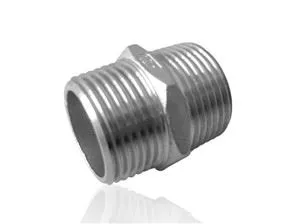
WIN-VIET offers elbows, tees, couplings, nipples and reducing fittings. Selected elbows and tees in our catalogue range from 1/8″ to 4″ nominal size, including 1″, 2″ and 3″. Depending on the model, fittings are available to ISO 4144 or MSS SP-114 specifications. Thread options include NPT (ASME B1.20.1), ISO 7-1 and ISO 228-1, and the catalogue lists selected models as 150 LBS. When the main line and branch are different sizes, select a reducing tee or another reducing fitting with the required size at each end.
2. Stainless Steel Threaded Ball Valves for Branch Shutoff
WIN-VIET offers one-piece, two-piece and three-piece ball valves. The two-piece full-port model featured in the catalogue is listed in nominal sizes from 1/4″ to 3″, with thread options including NPT (ASME B1.20.1), ISO 7-1 and ISO 228-1. The catalogue lists its pressure rating as 1000 WOG / PN63. Installing the valve upstream of the camlock allows operators to shut off the branch independently. Check the pressure–temperature chart for the selected model to determine its allowable working pressure under actual operating conditions.
3. Stainless Steel Camlock Couplings for Removable Hoses
The Type A and Type C camlock couplings in the catalogue range from 1/2″ to 4″, including 1″, 2″ and 3″. For example, a 2″ male-threaded outlet can be fitted with a 2″ Type A adapter with a matching female thread and paired with a 2″ Type C hose coupler. Type A pipe-thread options include NPT, ISO 7-1 and ISO 228-1, depending on the model. Match the Type C hose end to the hose inside diameter and attachment method. The lowest-rated component in the assembly-the coupling, gasket, hose or attachment-determines its allowable working pressure.
Where This Arrangement Is Used
Batch transfer between tanks. Fixed pipework brings liquid to the transfer outlet, and a hose connects to the receiving tank. At the end of a batch, isolate, depressurise and drain the line as required before removing the hose.
Multiple stations supplied from one main line. Tees form branches and individual ball valves control flow at each station. Hoses can be moved between stations with compatible connections and operating conditions.
Equipment filling or washdown. Keep a fixed supply outlet near the equipment, connect a hose when needed and remove it for storage afterwards. Check that the hose, coupling and gasket suit the actual fluid and operating conditions.
The same pipe layout may call for different materials and connections when the fluid changes. Check the fluid and its concentration, working pressure and temperature, and the limits of the complete hose assembly. For hazardous fluids, confirm whether the site requires a dedicated connection, such as a dry-disconnect coupling.
WIN-VIET supplies stainless steel threaded fittings, ball valves and camlock couplings. Browse our product range or send us your pipework sketch and connection requirements so we can help check which components will work together in your application.